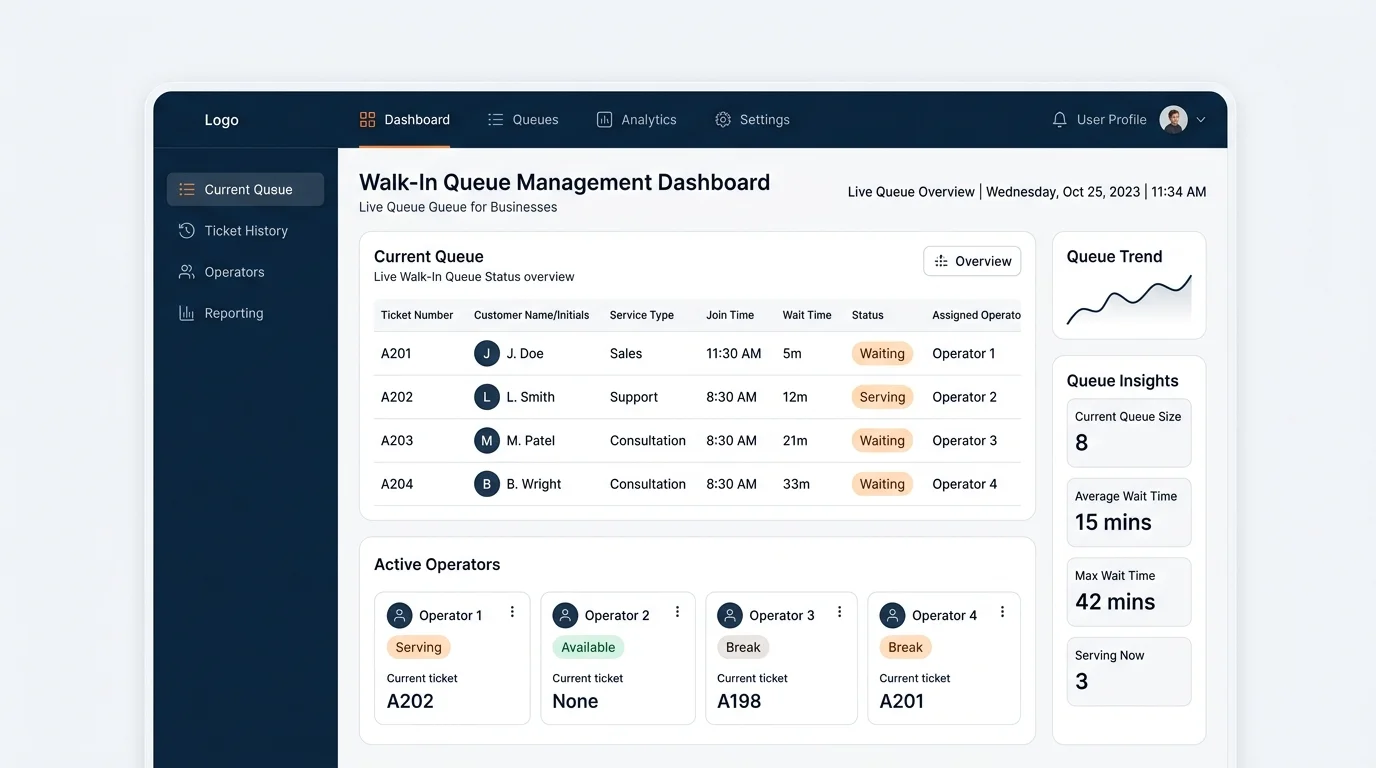
Walk-in queue management is the process of organising customers who arrive without an appointment, so they are served in a fair order and know how long they will wait. It replaces the traditional paper sign-in sheet or the “take a seat, and we’ll call you” approach with something clearer for both the customer and your team.
That is the short answer. The rest of this guide explains how walk-in queue management works, what it usually includes, and how it fits alongside appointment booking.
Key Takeaways
- Walk-in queue management handles customers who arrive without a booking. It controls the order of service and the waiting experience.
- It is different from appointment booking, which handles scheduled visits. Many businesses need both.
- A good queue system shows customers their place, gives an estimated wait, and notifies them when it is their turn.
- AppointLane combines walk-in queue management and appointment booking in one workspace, so teams can manage both types of customers without switching tools.
What Walk-In Queue Management Actually Does
At its core, a walk-in queue system does three jobs:
- Registers the arrival. The customer joins the queue, usually through a web browser or a front-desk tablet, and gets a place in line.
- Shows the wait. The customer sees their position or an estimated waiting time, so they are not left guessing.
- Calls them forward. When it is their turn, the system notifies them, and your team sees who is next.
Everything else, such as multiple service types, staff assignments, or reports, is built on top of those basics.
How It Works, Step by Step
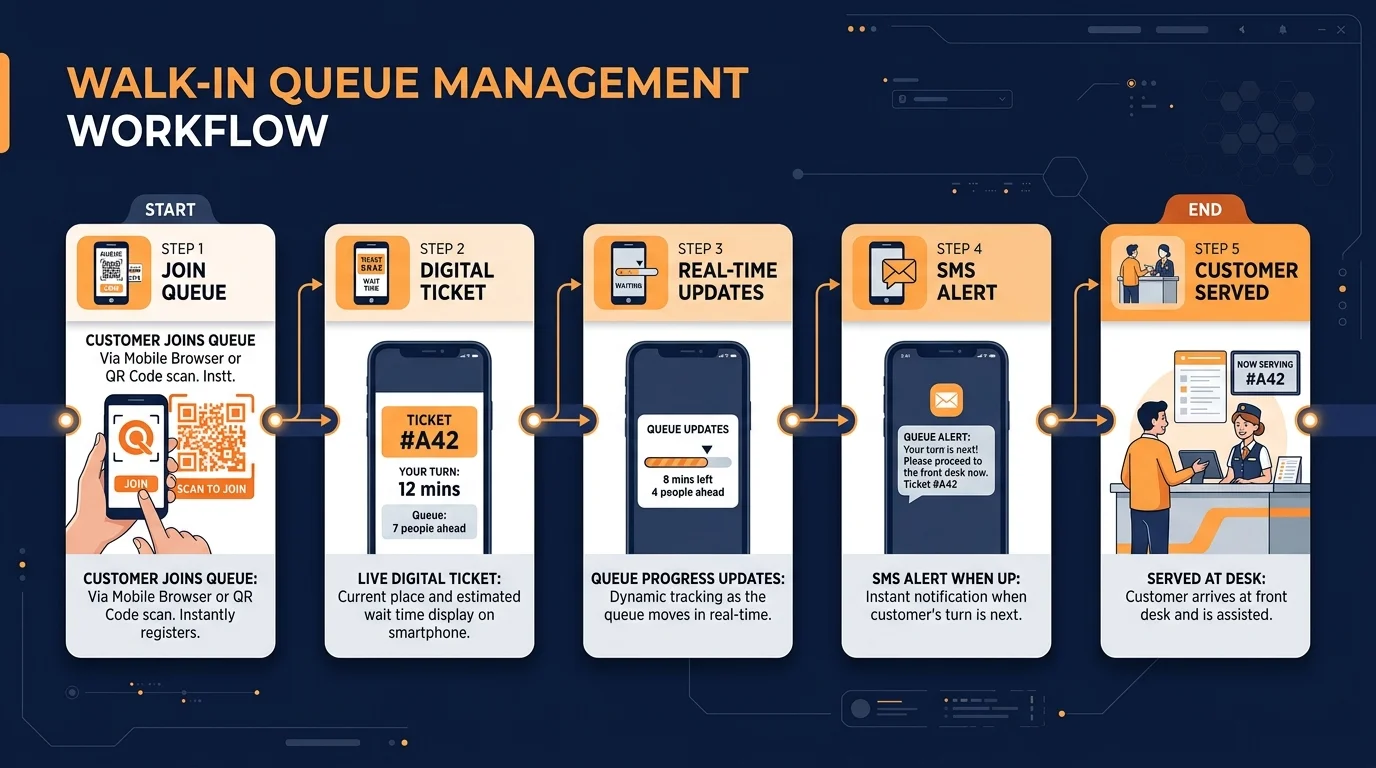
The flow is usually simple for both sides.
For the customer:
- They arrive and join the queue through a web browser. No app download is needed.
- They see their place in line or an estimated wait.
- They receive updates if the wait changes.
- They are notified when it is their turn.
- They are served.
For your business:
- You set up your services, staff, and queue rules.
- Walk-in customers are added to the queue as they arrive.
- Your team sees the queue in real time and calls the next person.
- Notifications go out automatically so customers do not have to keep checking.
- Reports show how many walk-ins you had and how long they waited.
This is the part that removes the guesswork from a busy front desk.
Common Features of Walk-In Queue Management Software
Not every tool includes the same things, but these are the features buyers usually look for:
- Virtual queue so customers can join without standing in a physical line (learn how a virtual queue for service businesses improves customer satisfaction).
- Customer notifications to tell people when their turn is near.
- Waiting time management so staff can see how long people have been waiting.
- Multiple services if you handle different types of visits.
- Staff and availability management so the right person is assigned.
- Multiple locations if you run more than one site.
- Client intake and document collection so paperwork is done before the visit.
- Reports and operational analytics to see peak times and wait trends.
- Calendar integrations so walk-ins and appointments appear in the same view.
Walk-In Queue Management vs. Appointment Booking
This is where a lot of businesses get confused, and it is worth separating clearly.
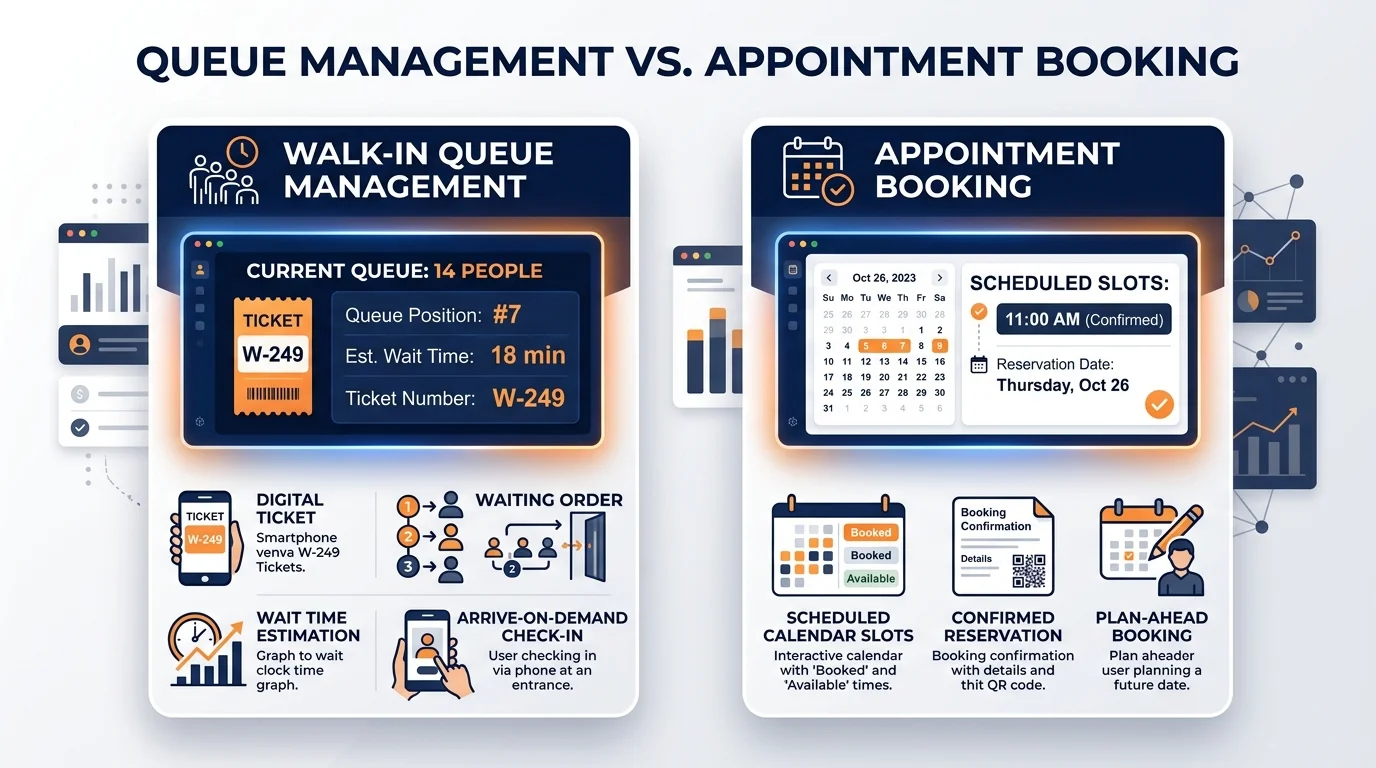
| Aspect | Walk-in queue management | Appointment booking |
|---|---|---|
| Who it is for | Customers who arrive without booking | Customers who plan ahead |
| What it controls | Order of service and waiting time | Time slots and schedules |
| Main problem it solves | Crowded waiting rooms and unclear wait times | Double bookings and phone tag |
| Typical customer action | Join a queue on arrival | Book a slot online |
Many service businesses deal with both types of customer on the same day. A law firm might book consultations in advance but also handle people who walk in with documents. A clinic might run appointments alongside walk-ins. A salon might take bookings all week and still get drop-ins on a Saturday. For a deeper operational breakdown, read our guide on appointments vs walk-ins.
When those two flows live in separate systems, staff end up juggling two screens and two lists. When they live in one workspace, the day is easier to read.
Why Businesses Move to Walk-In Queue Management
The reasons are usually practical rather than technical:
- Calmer waiting areas. Customers do not have to stand in a physical line or crowd the front desk.
- Fewer repeated questions. “How long is the wait?” is answered by the system.
- Better use of staff time. Your team focuses on serving people, not on managing a paper list.
- Clearer expectations. Customers know where they stand and can plan around it.
- A clearer view of the day. Everyone sees the same queue, including appointments.
None of this is magic. It is mostly the result of removing manual steps.
Who Typically Uses Walk-In Queue Management
These tools are common in service businesses where customers arrive without booking. That includes:
- Law firms and solicitors (learn how to implement walk-in queue management for law firms)
- Accountants and tax practices
- Consultants and agencies
- Clinics and healthcare practices (see our guide to clinic queue management)
- Salons and barbers (explore queue management for salons and barbers)
- Other service businesses that manage walk-ins, appointments, or both
If your business depends on serving people who turn up without a scheduled time, a queue system is usually worth considering.
What to Look for When Choosing a Queue Management System
A short checklist can save you from picking the wrong tool:
- Does it handle appointments too? If some customers book ahead, you need both flows in one place using an online appointment booking system.
- Is it easy for customers? If joining the queue takes more than a minute, people will not use it.
- Can customers use it without an app? Web-based queues are simpler for most customers.
- Does it send notifications? This is one of the most useful features in daily practice (see how notifications and appointment reminders eliminate missed visits).
- Does it support your staff structure? Think about multiple staff, different services, and varying visit lengths.
- Can it grow with you? Multiple locations and reports matter more as you scale.
- Does it fit your industry? A salon and a law firm do not need the same workflow.
Where AppointLane Fits
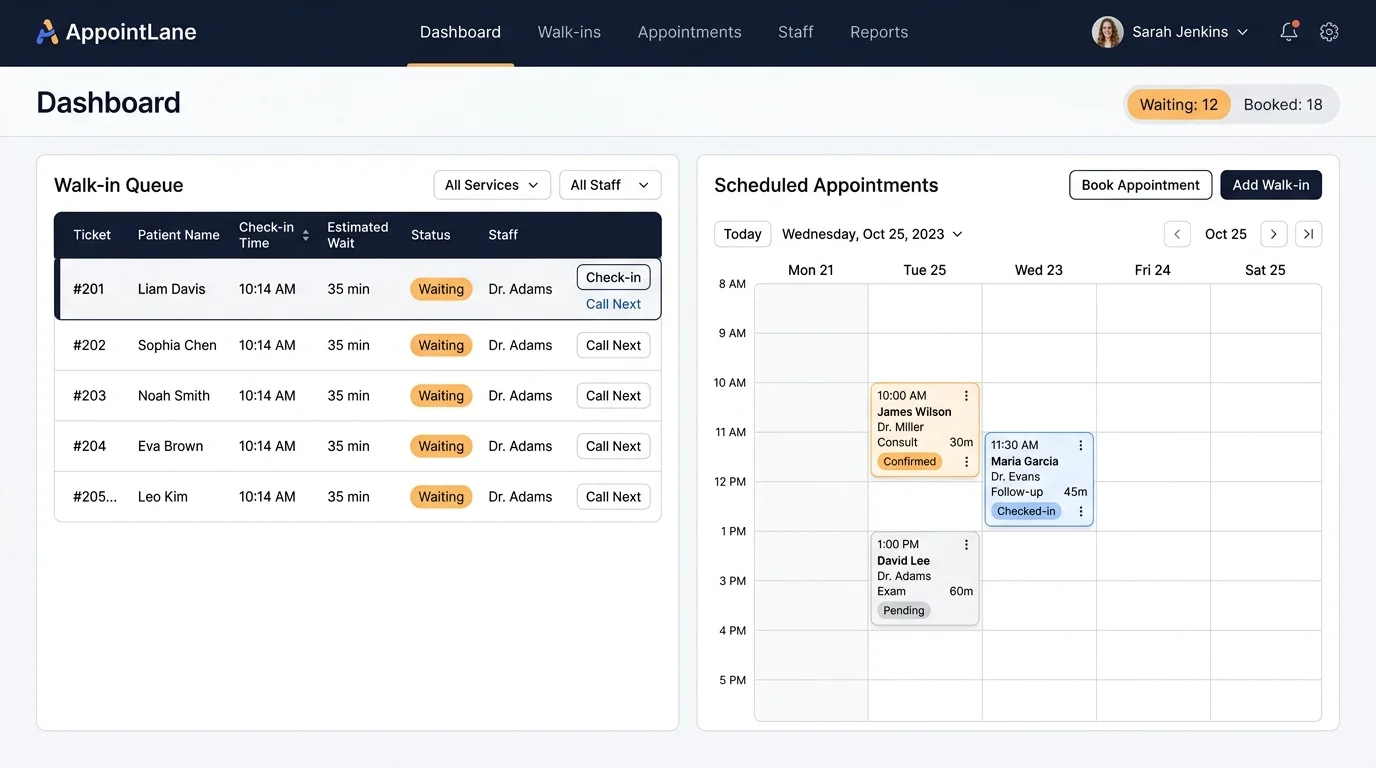
AppointLane is an online appointment booking and walk-in queue management platform for businesses that manage customer visits.
It combines scheduled appointments and unscheduled walk-ins in one workspace. That means your team can see booked appointments and arriving customers in the same place, instead of switching between two tools via appointment and walk-in management.
AppointLane helps businesses manage the customer journey from booking or arrival through to waiting and service. Key capabilities include:
- Online appointment booking
- Walk-in queue management
- Appointments and walk-ins in one workspace
- Customer notifications and reminders
- Rescheduling and cancellations
- Waitlists
- Staff and availability management
- Multiple locations
- Client intake and document collection
- Appointment payments
- Reports and operational analytics
- Calendar integrations
On the customer side, people can book appointments, join queues, receive updates, and manage their visits through a web browser. No dedicated customer app is needed.
If you run a business where some customers book ahead, and others simply turn up, that combination is the part worth paying attention to.
Walk-in queue management takes the uncertainty out of serving customers who arrive without a booking. It gives people a clear place in line, gives your team a clear view of the queue, and reduces the friction of a busy front desk.
The real question is not whether you need queue management. It is whether you want walk-ins and appointments running through two separate systems or one. You can explore AppointLane's features, book a demo of AppointLane, or start a 14-day free trial to get started today.
Frequently Asked Questions
What is walk-in queue management?
It is the process of organising customers who arrive without an appointment, so they are served in a fair order and know how long they will wait. It is usually supported by software that shows the queue and sends notifications.
How is it different from appointment booking?
Walk-in queue management handles customers who arrive without a booking. Appointment booking handles customers who schedule a time in advance.
Do customers need to download an app?
Not with AppointLane. Customers can join queues, receive updates, and manage visits through a web browser.
Can one system handle both walk-ins and appointments?
Yes. AppointLane is built around exactly that, with appointments and walk-ins managed in the same workspace.
What features should a small business look for?
At minimum: a virtual queue, customer notifications, waiting time visibility, staff assignment, and a clear daily view. If you also take appointments, booking matters too.
Which industries use walk-in queue management?
Common examples include law firms, accountants, consultants, clinics, salons, barbers, and other service businesses that manage customer visits.
Does a queue system reduce waiting time?
It makes waiting time clearer and easier to manage. It also helps staff see who has been waiting longest, which can improve how the queue is handled.
Can it work across multiple locations?
Yes, if the software supports multiple locations. AppointLane includes multi-location support.